A product creative often contains more rights than the team publishing it realizes. There is the photograph itself, but there may also be a product design, logo, package design, model’s likeness, background artwork, stock asset, typeface, slogan, influencer content, and AI-generated material inside the same image. That is why product image copyright is rarely as simple as asking, “Did we create this visual?” The more useful questions are:
Who created each part of the asset?
Who owns it or has permission to use it?
Whose brand, product, design, or likeness appears in it?
Where, for how long, and for what purpose may it be published?
A brand might legally sell a product without having permission to copy the manufacturer’s product photos. It might pay a photographer without receiving ownership of the photographs. It might have permission to use an AI output commercially without being able to claim copyright over every part of that output. The central principle is simple:
Rights do not automatically travel with the image file.
Possessing, downloading, paying for, or generating an image does not necessarily give a business every right connected to it. This guide explains how copyright and trademark issues affect product photos, advertisements, marketplace listings, influencer content, and AI-generated product visuals. It focuses on practical risk reduction for Shopify stores, Amazon and Etsy sellers, DTC brands, creative agencies, and marketing teams.
This article provides general information and is not legal advice. Copyright, trademark, advertising, privacy, and publicity laws vary between countries. Consult a qualified lawyer when making decisions about a specific campaign, dispute, contract, or high-risk use.
Copyright vs. Trademark in Product Creatives
Copyright and trademark are both forms of intellectual property, but they protect different things and address different risks. Copyright generally protects original creative expression. Original photographs can qualify because creative choices may appear in the angle, lighting, timing, composition, and positioning of the subject. Trademark law, by contrast, protects signs that identify the commercial source of goods or services, such as brand names and logos.
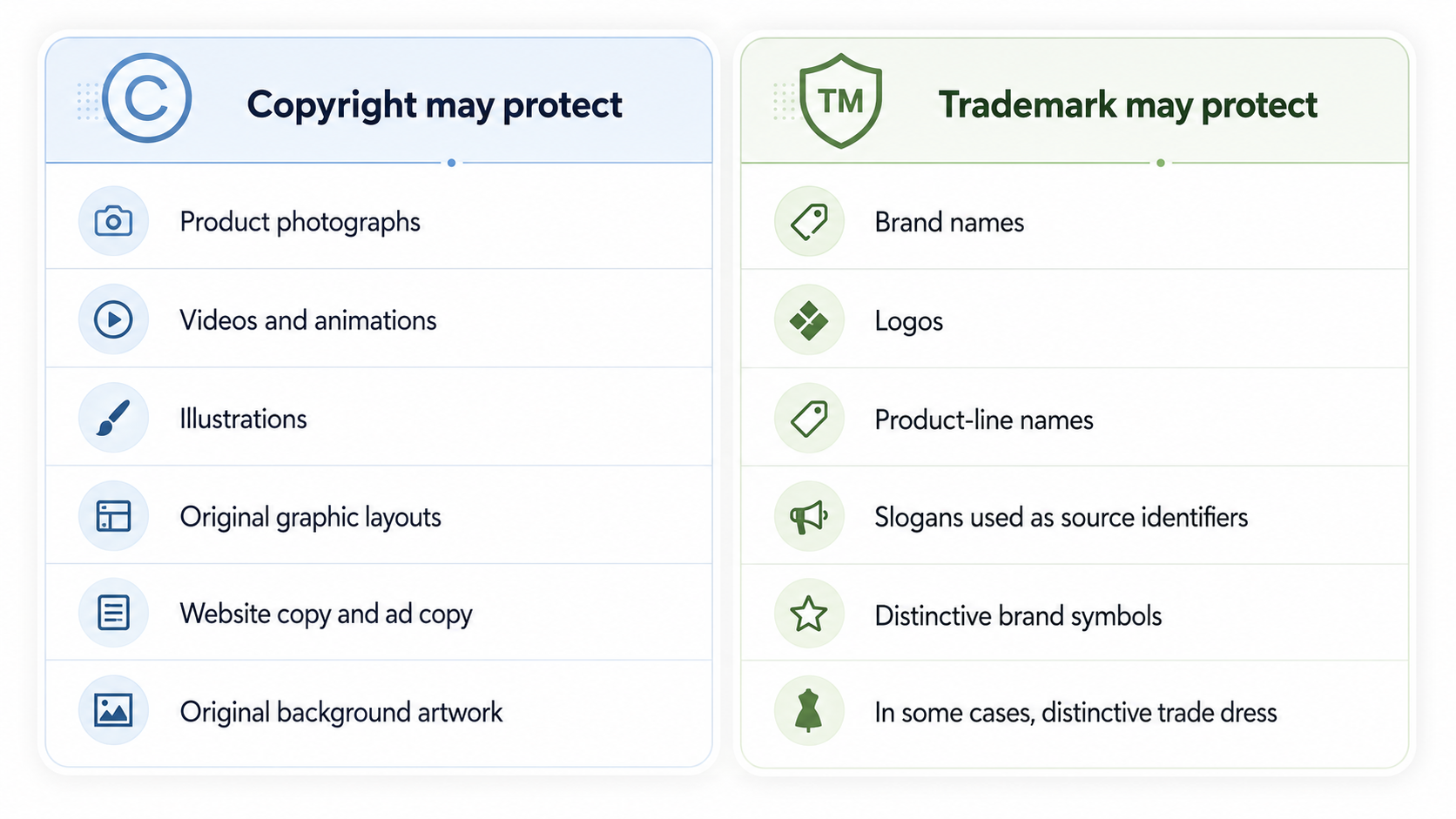
Trade dress can cover the distinctive visual appearance of a product or packaging, including elements such as shape, color, size, and texture, when that appearance identifies the product’s commercial source. The difference matters because the same creative can raise both types of issues. Imagine that your team photographs an authentic designer handbag. Your photographer may own copyright in the photograph, while the handbag manufacturer may own trademarks in the brand name and logo appearing on the product. The bag’s distinctive design or packaging may involve additional rights.
Taking the photograph does not transfer those underlying brand rights to the photographer. At the same time, owning the handbag or having permission to resell it does not automatically transfer ownership of another company’s promotional photography to the retailer.
Who Owns the Copyright to Product Photos?
In many countries, copyright protection begins automatically when an original work is created, without requiring registration. Registration can still provide important procedural or evidentiary advantages depending on the country. In the United States, copyright exists automatically when an original work is fixed, although registration or refusal is generally required before a copyright owner of a U.S. work can pursue an infringement lawsuit in federal court.
The harder question is not whether a product photograph can be protected. It is who owns the product photography copyright. The answer depends on who created the image, the working relationship, the contract, and the law governing that relationship.
Photos Created by Employees
When an employee creates product photographs within the scope of employment, the employer may own the copyright. This is an important distinction from hiring a freelancer. U.S. law treats qualifying works made for hire differently from ordinary creator-owned work, while UK guidance similarly notes that employers generally own copyright in images created as part of employment. However, job titles alone do not resolve every situation. A photographer employed specifically to create brand content presents a clearer case than an employee who takes photographs outside their normal duties.
Companies should still document ownership in employment agreements, intellectual-property clauses, internal creative policies, and contractor onboarding materials.
Photos Created by Freelancers and Agencies
Paying for a photoshoot does not always mean the client owns the copyright. A freelancer may remain the copyright owner while granting the client a license to use the images. A license is permission to use the work under specified conditions. An assignment transfers ownership of copyright.
UK government guidance expressly distinguishes licensing from assigning copyright and notes that image licenses may be limited by conditions and duration. U.S. work-for-hire treatment is also narrower than many businesses assume and depends on specific legal requirements rather than payment alone. Before approving a product photography contract, check whether it addresses:
Copyright ownership or assignment
Commercial usage rights
Paid advertising
Organic social media
Marketplace listings
Retailer and distributor use
Packaging and printed materials
Editing, cropping, retouching, and AI modification
Countries or territories
Duration
Exclusivity
Sublicensing
Archiving and reuse after the contract ends
Consider a brand that commissions images for its website. Six months later, the marketing team wants to use the same photos in Meta ads, Amazon listings, printed retail displays, and packaging in five countries. A narrow website license may not cover all of those uses.
The question is not simply, “Did we pay for the shoot?” It is, “What rights did the agreement actually give us?”
Supplier and Manufacturer Images
A retailer’s authorization to sell a product does not automatically grant permission to copy every image of that product found online. Amazon’s seller guidance states that sellers generally do not own photographs or videos taken from another website and should not upload that material to a product detail page without appropriate rights.
Supplier images should therefore be treated as licensed assets, not free assets. Ask the supplier for written confirmation covering:
Your company and storefronts
The specific images or asset library
Website and marketplace use
Paid advertising
Social media
Editing and resizing
International territories
Retail partners or affiliates
The period for which permission applies
A supplier’s casual message saying “you may use our pictures” is better than nothing, but it may still leave important questions unanswered. A structured authorization is easier to rely on if a listing is challenged later.
Also consider whether the supplier actually owns the images. A distributor may send retailers photos that were originally produced by a manufacturer, photographer, or agency under a restricted license.
Stock Photography, Templates, and Design Assets
Stock images are licensed, not automatically purchased outright. Licenses may distinguish between editorial use, commercial use, advertising, merchandise, resale templates, print quantities, audience size, and sensitive-use categories. UK copyright guidance notes that picture libraries commonly restrict image use through contractual terms. The same caution applies to:
Design templates
Mockup files
Fonts
Icons
Background textures
Music used in product videos
3D models
Preset scenes
Marketplace theme assets
A license that permits a stock image in a social post may not allow the image to become part of a product sold to customers. A template license may permit finished marketing outputs while prohibiting redistribution of the editable template.
Do not stop at the label “commercial license.” Read what “commercial” actually covers.
Influencer and User-Generated Content
When an influencer, customer, or UGC creator produces content featuring your product, your brand does not necessarily receive unlimited rights to that content. Permission to repost a video on Instagram is not automatically the same as permission to:
Run the video as a paid ad
Use it indefinitely
Edit the creator’s statements
Publish it in another country
Place it on a marketplace listing
Give it to retailers
Use the creator’s likeness on packaging
Train or operate an AI workflow with it
Copyright ownership and rights connected to a person’s name, image, voice, or likeness can be separate. Publicity and personality rights also differ significantly by jurisdiction.
UGC agreements should define the exact content, channels, duration, territory, editing rights, paid-media rights, and required disclosures. If a creator relationship is sponsored or otherwise involves a material connection, endorsement and advertising-disclosure rules may apply as well. The FTC states that endorsements must be truthful and not misleading.
Edited and Derivative Product Images
Editing a copyrighted image does not automatically remove the original owner’s rights. Cropping, changing the background, adding text, removing a watermark, applying a filter, or using AI to transform an image does not necessarily turn an unauthorized source image into a safe asset.
The owner of the original work may control adaptations or derivative uses, while genuinely new human-created elements could potentially receive separate protection. The exact result depends on the law, the license, and the nature of the changes. A practical rule is:
If you did not have permission to use the source image, do not assume editing it will solve the problem.
Can You Use Another Brand’s Logo in a Product Creative?
A trademark appearing in a photograph is not automatically an infringement. The risk depends on why the mark appears, how prominently it is used, what the advertisement communicates, and whether consumers may become confused about source, sponsorship, approval, affiliation, or endorsement.
The USPTO describes likelihood of confusion as a situation in which consumers may mistakenly believe related goods or services come from the same commercial source. EU trademark guidance similarly focuses on confusion about commercial origin. That makes trademark use in advertising highly contextual.
The Logo Appears on an Authentic Product
A logo may naturally appear when a retailer photographs a genuine branded product that it is lawfully selling. For example, removing every logo from a product listing could make it impossible to identify the actual product. However, authenticity alone does not give the seller unrestricted freedom to use the mark in any design or message.
The presentation should not falsely suggest:
An official partnership
Brand-owner approval
Exclusive authorization
Sponsorship
A co-branded campaign
A relationship that does not exist
The safest creative usually presents the mark only to the extent reasonably necessary to identify the genuine product.
The Product Is Compatible with Another Brand
Compatibility claims often require referring to another brand. A phone-case seller may need to explain that a case fits a particular phone model. An accessory company may need to identify the device, platform, or product with which its item works.
Such references should be accurate, limited, and visually structured so that customers understand which company produced the advertised product. Avoid making the third-party logo more prominent than your own brand. Avoid visual treatments that imitate the other company’s official product page or campaign. A clear statement such as “compatible with” can be safer than a layout that visually implies the accessory is manufactured or endorsed by the referenced brand.
Because trademark exceptions and nominative-use doctrines vary by jurisdiction, high-value compatibility campaigns should be reviewed locally.
Comparative Advertising
Comparative advertising is not automatically prohibited. The FTC has stated that truthful and non-deceptive comparative advertising can provide useful information to consumers, particularly when the basis of comparison is clearly identified.
But a lawful comparison must be supportable. A claim such as “lasts twice as long as Brand X” can create evidence and substantiation obligations. The comparison should use current, like-for-like information and should not manipulate product scale, packaging, performance, or test conditions.
The use of a competitor’s logo may also create a separate trademark question. In many cases, using the competitor’s name in plain text may communicate the comparison without making its logo a dominant design element.
Incidental Background Logos
A small logo appearing incidentally in a real-world scene is different from deliberately placing a large third-party logo in the center of an advertisement. Still, “incidental” is not a magic legal category that makes every use safe. Context matters.
Ask:
Is the logo necessary to the scene?
Is it readable?
Does it attract attention?
Could viewers think the logo owner participated?
Would removing or blurring it preserve the creative concept?
Does the destination platform apply stricter rules than the law itself?
For paid advertising, clearing unnecessary third-party branding is usually the cleaner operational choice.
Decorative or Unnecessary Logo Use
Using a well-known logo purely as decoration creates avoidable risk. A logo on a wall, shopping bag, laptop, bottle, or piece of clothing may make a generated scene feel realistic, but it can also imply a brand relationship or use another company’s reputation to improve your own campaign.
If the mark does not help identify an authentic product, explain compatibility, or make a legitimate comparison, ask why it is there.
“Because it makes the image look premium” is not a strong rights-clearance rationale.
Implied Sponsorship and Endorsement
The most important question is often not whether a logo is visible. It is what the full creative communicates. Consider the combined effect of:
Logo size and placement
Brand colors
Layout
Headline
Product positioning
Captions
Landing-page copy
Influencer language
Badges such as “approved,” “official,” or “partner”
Packaging shown in the scene
A creative may imply endorsement even if the text never explicitly claims a partnership. Trademark law and advertising law both examine the message consumers are likely to receive, not only the advertiser’s private intention.
Copyright and Trademark Risks in AI-Generated Product Images
AI-generated product visuals introduce speed and scale, but they do not eliminate rights-clearance work. For e-commerce teams, three separate questions must be considered.
1. Does the Platform Permit Commercial Use?
This is a contract question. The AI platform’s terms may give users permission to use outputs commercially, but the details can vary by plan, output type, account status, input source, geography, and prohibited-use rules.
Review:
Output ownership language
Commercial-use permissions
Restrictions on specific content
Responsibility for third-party claims
Input-image requirements
Indemnity provisions
Model or stock-asset terms
Whether terms can change
Whether old outputs remain covered after account cancellation
Commercial permission is important, but it is only the first layer.
2. Is the Output Protected by Copyright?
This is a copyrightability question. In its 2025 report, the U.S. Copyright Office concluded that material generated entirely by AI is not copyrightable under current U.S. law. It also stated that prompts alone generally do not provide sufficient control, while human-created expression, creative selection and arrangement, and sufficiently creative modifications may be protected. AI used as an assistive tool does not prevent copyright protection for human-authored parts of a larger work.
This creates an important distinction:
Permission to use an AI image commercially does not necessarily mean that every part of the image is protected by copyright or that the user can prevent competitors from generating something similar.
The analysis is also not identical worldwide. The U.S. Copyright Office’s report notes that countries are taking different approaches and that some legal systems contain specific provisions for computer-generated works.
For global campaigns, do not assume one country’s AI copyright position applies everywhere.
3. Could the Output Infringe Someone Else’s Rights?
This is an infringement-risk question. An AI platform may permit commercial use while an individual output still contains problematic material.
Review the output for:
Recognizable third-party logos
Near-copies of branded packaging
Famous fictional characters
Protected artwork
Watermarks or signatures
Celebrity likenesses
Distinctive advertising campaigns
Competitor trade dress
Product designs not supplied by your brand
Misleading certification marks or badges
Commercial-use permission from the platform is not a guarantee that every generated image is free from third-party claims.
Using Copyrighted Input Images
The input matters as much as the output. Before uploading a product image, stock asset, competitor advertisement, influencer photo, or marketplace screenshot to an AI tool, ask whether your rights allow that use.
A license that permits publishing an image may not necessarily permit:
Uploading it to a third-party AI service
Generating adaptations
Combining it with other assets
Using it as a persistent project asset
Sharing it with collaborators
Using the results in paid advertising
The fact that an image is publicly visible online does not mean it is free to copy or upload. UK guidance, for example, states that users generally need permission to copy or share protected images online, and Amazon similarly warns sellers against taking photographs from other websites.
Accidental Logos and Brand Elements
Generative systems can create pseudo-logos, distorted brand names, or packaging that resembles a familiar product. These details are easy to overlook when a team is generating dozens of variations.
Zoom in before publishing. Check:
Product labels
Clothing
Screens
Store signs
Bottles
Boxes
Vehicles
Accessories
Background posters
Small text
Repeating patterns
A fictional-looking mark may still be confusingly close to a real one. A distorted logo is not automatically harmless.
When a third-party mark is unnecessary, remove or replace it before export.
Imitating Recognizable Packaging or Campaigns
Prompts such as “make this look exactly like Brand X’s campaign” create more risk than prompts describing general visual qualities. A safer creative brief identifies the actual characteristics the team wants:
High-key studio lighting
Warm editorial shadows
Minimal cream background
Reflective metallic surface
Symmetrical composition
Documentary-style handheld framing
Bold typographic hierarchy
This produces a more useful creative direction than asking the system to copy a particular brand. General creative techniques are not the same as reproducing protected expression, distinctive packaging, or source-identifying visual presentation.
Human Creative Contribution
A strong AI workflow should preserve human decisions rather than treating the first output as the finished asset. Human contribution may include:
Selecting source assets
Directing the composition
Combining multiple elements
Choosing among outputs
Rewriting text
Correcting product details
Replacing backgrounds
Adjusting lighting
Creating a sequence
Adding original typography
Making substantial edits
Arranging assets into a broader campaign
Those steps matter creatively and operationally. In the United States, they may also affect which human-authored elements qualify for copyright protection.
Product Accuracy and Misleading Visuals
A product creative can avoid copyright infringement and still create advertising risk. The FTC states that advertising must be truthful, non-misleading, and appropriately supported. Express and implied objective claims can both require substantiation.
An AI-generated image can make implied claims about:
Product size
Color
Material
Fit
Quantity
Packaging
Included accessories
Performance
Ingredients
Results
Durability
Compatibility
Environmental impact
Suppose AI makes a small table look large enough to seat eight people. The image has communicated something about scale even without written copy.
Or suppose a cosmetics visual shows a dramatic skin result that the product cannot reasonably deliver. The image may function as a performance claim.
E-commerce teams should compare the final output against the real product before publishing. The goal is not only visual consistency. It is commercial accuracy.
Marketplace Rules for Product Creatives
Legal permission and platform permission are not always the same. Amazon, Etsy, Shopify, Meta, and other platforms operate their own intellectual-property and advertising policies. A creative may be challenged, restricted, or removed through a platform process before a court makes any decision.
Amazon warns sellers not to upload photographs or videos taken from another website without appropriate rights. Etsy maintains a reporting process for alleged copyright and trademark infringement and can remove material following a policy-compliant report. Shopify states that merchants must respect valid intellectual-property rights and provides separate procedures for copyright, trademark, and trade-dress reports. Meta’s advertising standards prohibit ads that violate third-party copyright, trademark, or other intellectual-property rights.
Marketplace policies also change. Before launching a campaign, review the current policy for the actual destination—not a screenshot, old blog post, or remembered rule.
Keep in mind that a platform accepting an upload does not confirm that you own the rights. Automated approval is not legal clearance.
A Pre-Publish Rights Checklist for Product Creatives
Use this checklist before publishing a product image, advertisement, video, marketplace listing, or AI-generated visual.
Ownership and Licensing
Do we own the original photograph or have a written license?
Does the license cover commercial use?
Does it cover paid advertising, not only organic content?
Does it cover the intended countries and platforms?
Are editing, adaptation, and AI-assisted modification permitted?
Can retailers, agencies, affiliates, or distributors use the asset?
Is the license still active?
Trademarks and Third-Party Content
Are any third-party logos, brand names, slogans, or packaging visible?
Are they necessary to identify an authentic product or explain compatibility?
Could the layout imply sponsorship, partnership, approval, or endorsement?
Does the creative imitate a competitor’s distinctive campaign or trade dress?
Are all stock assets, fonts, icons, templates, and music properly licensed?
People and Places
Are model, influencer, or creator permissions documented?
Does the permission include paid advertising and editing?
Are any customer photographs or testimonials being used beyond the original consent?
Are recognizable private locations, artwork, or branded environments present?
AI-Specific Checks
Did we have the right to upload every input?
Do the platform terms permit the planned commercial use?
Did the output generate accidental logos, characters, signatures, or watermarks?
Can we identify the human edits and creative decisions?
Does the final image accurately represent the real product?
Have we saved the original inputs, output versions, and approval history?
Platform and Evidence
Does the destination marketplace allow this type of creative?
Can we produce the relevant contract, license, authorization, or release?
Can we identify who approved the final version?
Could we explain the asset’s origin if a platform or rights owner challenged it?
A ten-minute review before launch is easier than reconstructing rights months later after the employee, freelancer, agency, or supplier involved has moved on.
What to Do When Someone Copies Your Product Images
When another seller copies your photographs, avoid beginning with an emotional public accusation. Start by preserving evidence.
Save:
Original camera files
Raw files and metadata
Editing files
Draft exports
Creation dates
Contracts
Copyright assignments
Licenses
Invoices
Emails
Project histories
Screenshots of the copied material
The complete page URL
Seller or account details
Dates and times
Evidence of where your original appeared first
Then identify the actual issue. Is the other party copying your photograph, using your trademark, selling a counterfeit product, or doing several of those things at once? Copyright and trademark complaints often require different evidence and different reporting forms.
Use the platform’s official intellectual-property reporting system. Etsy, Shopify, Amazon, and Meta each maintain their own processes. Do not send a copyright complaint merely because you dislike a competitor’s content; a formal notice can have legal consequences.
In the United States, the DMCA notice-and-takedown system allows copyright owners or authorized agents to notify qualifying online service providers about allegedly infringing material. A compliant notice requires specific information, including identification of the protected work, location of the allegedly infringing material, contact details, good-faith and accuracy statements, and a signature. The uploader may also have a counter-notice process.
For valuable campaigns, repeated infringement, counterfeiting, international disputes, or contested ownership, speak with a lawyer before escalating.
How a Better Creative Workflow Reduces Rights Confusion
Intellectual-property problems are often treated as legal problems alone. In practice, many begin as workflow problems.
A team downloads a supplier image without recording its source. An agency delivers exports without the contract being attached to the project. A freelancer’s license sits in one employee’s inbox. An AI variation is approved, but nobody knows which input image created it. Six months later, the brand cannot prove where the creative came from.
The safest creative workflow is not simply the one that produces the most images. It is the one that keeps original inputs, approved assets, edits, variations, and final exports organized and traceable.
Adject v2.0 is designed as a project-based creative workspace rather than a one-off image generator. Its canvas, reusable asset system, project context, and connected visual variations are intended to keep products and creative work together across an ongoing workflow. Adject also states that users may use generated outputs commercially and that it does not claim ownership of user outputs, while users remain responsible for legal compliance and avoiding third-party infringement.
That does not make Adject—or any creative platform—a substitute for legal clearance. It does, however, support a more disciplined operational model:
Keep original product uploads connected to the project.
Separate approved brand assets from unverified references.
Preserve variations instead of downloading anonymous files.
Maintain context around edits and outputs.
Review generated visuals before commercial publication.
Keep licenses and approvals alongside the internal campaign record.
Technology can make rights management easier to organize. It cannot decide every legal question for the business.
When Should an E-commerce Brand Ask a Lawyer?
Routine internal content may be manageable through clear contracts and a consistent checklist. Legal review becomes more important when:
A campaign prominently uses a competitor’s trademark
The advertisement makes aggressive comparative claims
A logo use could imply partnership or endorsement
The brand is entering several countries
A product design or packaging closely resembles a competitor
A celebrity or identifiable public figure appears
AI has been used to reproduce a recognizable campaign or character
A high-value photography contract contains unclear ownership terms
A rights owner has sent a formal complaint
A marketplace has suspended a listing or account
The other party has filed a counter-notice
Counterfeit products are involved
The campaign may create significant financial or reputational exposure
Legal review is most effective before a major campaign launches, not after every channel has published it.
Final Takeaway
Product creatives are business assets, but they are also bundles of rights. The photograph may have one owner. The logo may have another. A model may control commercial use of their likeness. A stock provider may restrict the background. An AI platform may grant commercial permission without guaranteeing copyright protection or freedom from third-party claims.
That is why the right question is not:
“Do we have the image?”
It is:
“Do we have the rights required for this exact use?”
A reliable e-commerce workflow combines creative speed with documentation, review, product accuracy, and traceable approvals. Before publishing, confirm four things:
Who created the asset?
Who owns or licenses it?
Whose brand, work, design, or likeness appears in it?
Where and how are you allowed to use it?
Answer those questions consistently, and copyright and trademark review becomes part of the creative process not an emergency that begins after the campaign is already live.


